- From the Desk of Phil Mills
- Posts
- Logistics Teams Don’t Have to Be ‘Fully Ready’ to Get Value from AI
Logistics Teams Don’t Have to Be ‘Fully Ready’ to Get Value from AI
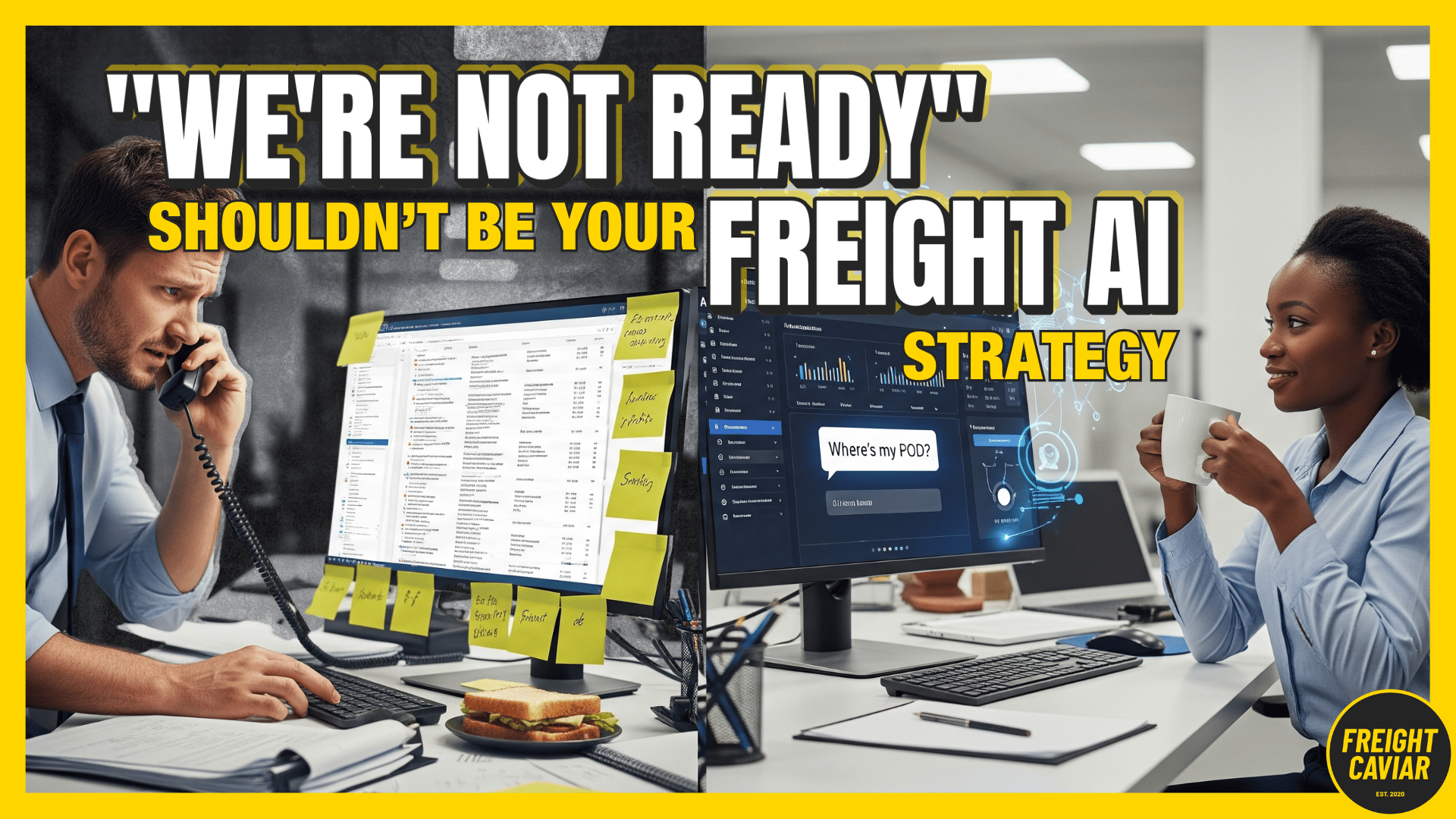
“We’re not ready.”
If you’ve said this about implementing AI in your freight operations, you’re not alone. The hesitation often stems from managing complex, non-integrated systems. When teams are juggling manual-heavy workflows across tools and departments, introducing AI can seem like just another layer of complexity, when in reality, it can be the relief valve.
And it’s a valid fear.
AI can sound like a massive, disruptive project that requires months of change management, developer hours, and risky transitions. But the truth is, you don’t need a full rollout to see real ROI. In fact, some of the most impactful results come from small, low-lift pilots that solve specific problems fast.
Let’s break down why a phased approach is not only safer, but also smarter.
Why Freight Teams Get Cold Feet Around AI
The logistics industry thrives on predictability and speed, but the backend operations are often built around manual-heavy workflows and legacy systems, efficient in their time, but now strained by today’s communications volumes.
When operations leaders hear “AI,” many imagine:
A full platform overhaul
Endless integrations
Workflow disruption
Staff needing to learn (and trust) yet another new tool
Add to that the myth that AI adoption is "all or nothing", and the result is predictable: hesitation. In fact, 58% of executives surveyed by McKinsey in 2024 said lack of readiness was the #1 barrier to scaling AI across their organization.
You don’t need to be “ready” for everything. You just need to be ready for one thing.
The Case for Starting Small
The most effective AI strategies start with a single pain point.
It might be:
The high volume of vendor calls asking for payment status
Missed follow-ups with AR collections
Carrier reps overloaded with repetitive inbound calls
“In our case studies, we found that focusing on a small number of high-impact use cases in proven areas can accelerate ROI with AI, as can layering generative AI on top of existing processes…” – Deloitte, State of Generative AI in the Enterprise 2024 Report
Proven Phases of AI Rollouts (Backed by Research)
The most successful AI adoption strategies don’t try to overhaul everything at once. They move in phases, building trust, proving ROI, and minimizing disruption at every step. Here’s what that typically looks like in practice:
Stage
Explanation
Freight Ops Example
Pilot Phase
Identify a high-impact, low-risk workflow. Test a single use case with clear performance metrics.
Launch an AI-powered virtual agent to handle vendor document retrieval or carrier payment status calls.
Validation Phase
Measure success using KPIs: reduced call volume, faster response times, improved invoice accuracy.
Track a 40% drop in inbound AP inquiries and use the data to pitch internal expansion to leadership.
Controlled Expansion
Scale AI to adjacent workflows, such as expanding from AP to AR or from inbound to outbound support.
Deploy an AR agent to follow up on aging invoices, or a carrier support agent to assist with rate confirmations.
Full Integration
Once confidence and impact are proven, integrate AI into broader systems (TMS, CRM, WMS) via APIs.
Connect all agents into your TMS and
CRM for unified visibility and real-time performance dashboards.
This approach allows freight and logistics teams to test, learn, and optimize without bringing the whole operation to a halt. Plus, they help your team build trust in the process, win small, and stay in control – so no one feels like AI is being “done to them.”
Lessons from Early Adopters
If there’s one pattern that stands out among successful AI adopters, it’s this: the winners don’t try to do everything at once. Instead of launching massive transformations, they focus on a few critical domains, prove value fast, and expand with confidence. Recent research from McKinsey & Company reinforces what early adopters in freight and logistics are already discovering:
Phased Success is not a Shortcut. It’s a Strategy.
Value Comes From Real KPIs
Adoption Takes Investment, But Doesn’t Have to Break You
So when leaders say, ‘We’re not ready,’ it often just means they’re prioritizing the urgent over the long-term. A more helpful question might be: What’s one small win we can tackle right now?
From Insight to Action
For many logistics teams, the barrier to AI adoption is simply time and knowing where to start. With limited bandwidth, even smart solutions can feel out of reach.
CloneOps.ai was built with that reality in mind.
Their AI-powered virtual agents are designed for freight workflows first (think: document collection, payment status calls, invoice follow-ups, and carrier communication). But what makes CloneOps.ai stand out is how they’re deployed.
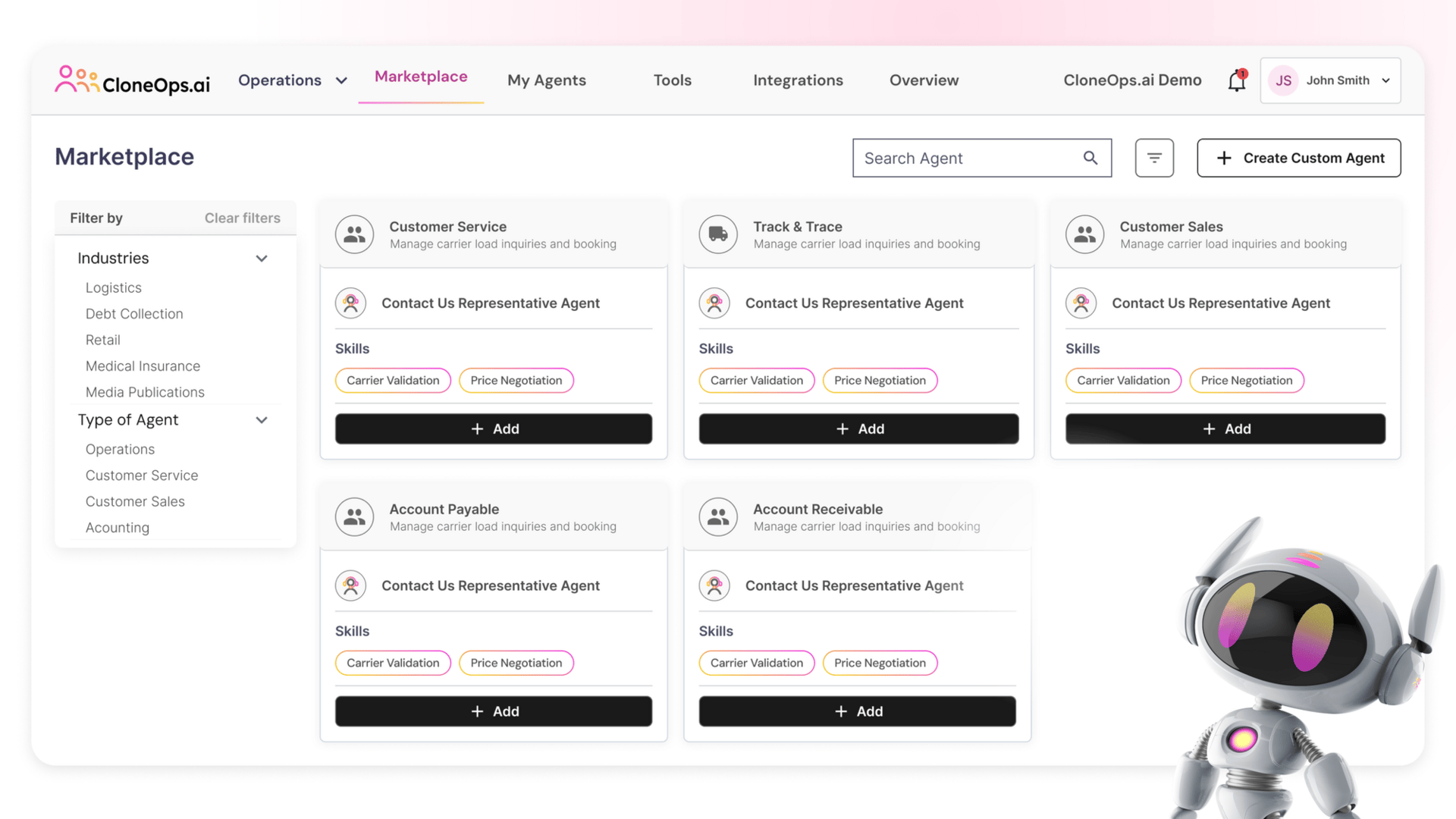
A screenshot of the CloneOps.ai agent marketplace interface. The dashboard displays multiple customizable AI agent cards, including roles like Customer Service, Track & Trace, Customer Sales, Accounts Payable, and Accounts Receivable.
Instead of pitching a top-down overhaul, CloneOps.ai starts small:
One agent, focused on a single task
Minimal lift from your team
Clear KPIs to measure ROI
Built-in integration with your existing systems (TMS, CRM, or otherwise)
It’s a low-risk, high-impact entry point that lets ops teams see results fast, without the need for extra headcount or six months of IT resourcing.
And once an agent proves itself, expansion is easy. Teams can move from AP to AR, from inbound to outbound communication, and from reactive service to proactive support. CloneOps.ai helps teams scale AI at the pace that fits their business.
In short, you don’t need to be ready for everything. You just need to start where it matters.
Your AI Rollout Doesn’t Have to Be a Roll of the Dice
With CloneOps.ai, logistics teams get a partner who works with you to deploy agents where they’ll deliver the most impact, without upending your operations. Start with one task, prove the value, and grow from there with CloneOps.ai supporting every step.
Ready to start? Book a quick demo or explore more at CloneOps.ai
Sign up for FreightCaviar
The only newsletter you need for freight broker news & entertainment.
No spam. Unsubscribe anytime.
Reply